





For small defects in one or two teeth, Dr. Rothwell will generally use tooth bonding. Sometimes, if the situation requires it, she will do an entire smile with this direct technique. You can view examples of her beautiful work in our smile gallery. Here is an explanation of what makes this treatment different from porcelain veneers:
Artistry is required for tooth bonding:
Tooth bonding requires artistic talent on the part of the dentist. It is done freehand, at the chair, rather than in a laboratory. Dentists without artistic ability are uneasy about attempting this type of treatment. Dr. Rothwell, however, is a highly skilled artist and dentist that can do this work and produce beautiful results.
Made out of composite instead of porcelain:
Bonding materials are a tooth-colored composite paste that is hardened with the use of a curing light. While they are very durable, they aren’t quite as strong as porcelain.
One appointment instead of two:
Porcelain veneers are made in a laboratory, and thus they require two visits. With this technique, you can walk out of the office after one appointment with a new smile.
A more conservative treatment:
Healthy tooth structure doesn’t need to be ground away. A little roughening of the surface of the tooth is all that’s required to bond the composite to the tooth.
Newer composite materials enable a dentist/artist to imitate the natural tooth in form, color, and texture. Defects in your teeth can truly be repaired to where they are undetectable, and your confidence in your smile can be fully restored. While porcelain veneers are great for complete smile makeovers, tooth bonding is ideal for spots, chips, broken front teeth, or discolorations. Gaps between your front teeth can be closed in one appointment. With her artistic ability, Dr. Rothwell can restore beauty to your smile.
Extensive training and considerable artistic ability is required to properly apply this treatment. Many dentists have difficulty matching and blending colors and translucencies, as well as sculpting the tooth and polishing the composite to the same luster as the natural teeth. For this reason, many don’t like to do direct tooth bonding.
Here is a direct tooth bonding case performed by Dr. Rothwell. This patient had an accident that broke off one of the front teeth. Many dentists would want to grind that tooth down and put a porcelain fused to metal crown on it. Some even suggest placing two crowns, one on each front tooth, so that they look the same.
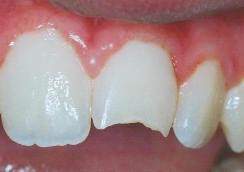
Bonding Tooth Before
Notice, however, that Dr. Rothwell has been able to repair this tooth in one appointment, shaping the tooth so that it looks perfectly natural and like the other tooth. The color blending also requires artistic skill. Notice how the color in the tooth changes over the length of the tooth and from side to side. She has beautifully re-created the whitish halo right at the biting edge of the tooth. Above that, there is a translucent zone, then there is a zone where there is a little yellow in the tooth.
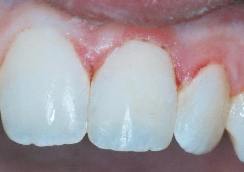
Bonding Tooth After
The shaping of the tooth bonding has been done perfectly also, and she has placed ridges in the front surface of the repaired tooth that cause vertical reflection highlights. Slight irregularities have been placed in the biting edge of the tooth, because that’s what its companion tooth has. When those irregularities are present, it contributes to a youthful look, because front teeth, when they are young, all have these irregularities, which are called mammelons.
See more of Dr. Rothwell’s beautiful smile artistry in our smile gallery.